Moore Financial Solutions 1st Quarter 2026
The past 35 days have humbled investors as we witnessed the S&P 500 lose approximately 6% from February 25th into the quarter's close. The S&P 500 finished the entire quarter 4.6% lower, which represents the first losing quarter since Q1 of last year, in which the S&P 500 lost about 4.59%. Much like an emotional play or movie, the market offered three scenes of varying benefit to investor portfolios. Scene one was brief but fruitful. In these first 12 days of the year the S&P 500 rose about 1.92%. Scene two left investors leaning on the emotional lessons learned from 2025's market downturn, with the S&P 500 moving about 9% lower from day 13 of the year until March 30th. Scene three flashed quickly and only represented one day. On this last day of the quarter, the S&P 500 meaningfully rose about 2.9% in an effort to heal a portion of the quarter's losses. I believe, based upon my nearly 14 years of money management, that stock market history doesn't repeat itself, but it does rhyme. Though I'm not predicting a positive year for the S&P 500 (and admittedly not in the business of making such predictions) this year's chart for the broad stock market looks somewhat like last year's. Those first quarter '25 stumbles were later looked at as a massive buying opportunity, symbolizing the power of "buy and hold" as it relates to stocks. Only time will tell if these stock market worries are warranted and if there will be continued damage to stock portfolios because of the conflict in Iran. Additionally, the market is eyeing oil price increases, interest rate increases, various geopolitical risks, and the additional unforeseen risks on the horizon. Or are stock market investors currently pricing in many areas of worry, all of which will subside in the coming weeks? Dive into the quarter's review in which I attempt to illustrate investing through my eyes, discuss quarterly geopolitical events, and speak to market moving factors of Q1 and investor emotions as a result. Use this tool to educate yourself and reduce worry or fear as it relates to investing.
The amazing thing about fiduciary* management is that as portfolio managers we can live vicariously and benefit from lessons learned generations ago. Though stock market investing has changed a lot technologically from generation to generation, and will continue to evolve, the emotional relationship with investing remains reasonably unchanged. About 400 years ago Holland experienced what is likely the first recorded financial bubble when speculation drove tulip values to as much as six times the average person's annual salary at the market's peak, prior to a crash. This feeling of greed (a 1630's Holland tulip purchaser hoping to be a tulip owner lucky enough to later sell at a higher price) coincides with "fear" to drive market pricing day to day. In the late 1990's we witnessed investors in a similar fashion illustrate greed as they feverishly bought up ".com" companies regardless of actual earnings and financial reporting data. In 2008 during the Great Financial Crisis, we saw investors become very fearful and sell equities in a panic. These emotions of fear and greed drive the markets day to day and week to week. We believe investors have never been more willing to "gamble" or exercise "greed" as witnessed in the rise of popularity of leveraged exchange traded notes, near expiration options, etc. In our present day, this appetite for speculation/risk could be driving the price of oil higher or pushing shorts on equities harder during war times. In other words, investors' greed and desire to make money can quickly swing markets as the ultra-speculative may actually bet against the market in an attempt to benefit from market decreases.
But we must overcome this temptation to let short-term movements in the valuation of stocks rattle us and instead stay focused on longer term outlooks such as 1, 5, or even 10 years.
Over the last several generations the world economy has become increasingly interwoven. Trade routes and relationships have generally strengthened, and this has allowed goods to flow all over the world as needed. Unlike 50 or 75 years ago when economic health may have been driven more locally, we now live in a world that trades freely, and we can get the goods we desire shipped right to our door or sell our goods all throughout the world. As a side effect of this chain of global trade, we have become more dependent on the other links in the chain, in this case our trading allies. In other words, the health of one nation's economy may rely significantly on the health of another nation's economy. As we manage portfolios we often aim to be invested meaningfully in stocks to best impact our clients' lives by hopefully providing meaningful growth. However, we move cautiously knowing the next big risk is out there. For years MFS has viewed risks as most commonly geopolitical with a recent example being the Russian invasion of Ukraine. This impact to the world economy was a result of the action by Russia, a 6.3 million square mile country that represents 11% of the world's landmass. While it may seem somewhat natural that extreme actions by a world power could throw the global economy into a recession, what are the chances that a 21-mile-wide body of water could spur a global recession?
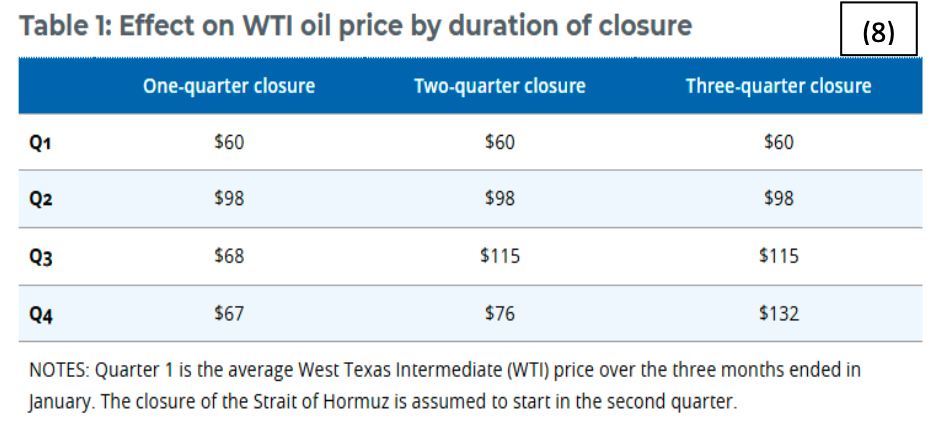
That roughly 21-mile-wide body of water, the Strait of Hormuz, realistically can create a recession. These 21 miles provide a shipping route for most oil produced in the Persian Gulf, about 80% of which then flows to Asia. But with the potential for a $500 Iranian drone to sink passing vessels the ultimate concern has become attacks on oil shipping in the Strait, causing unsustainable losses or shipwrecks closing the shipping lanes. Suddenly, the waterway supplying roughly 20% of the world's oil is closed due to Iranian threats. Basics of supply and demand theory suggest a higher price of oil when a 20% decrease in supply occurs, not to mention an estimated 18%-20% the fertilizer used on United States farms is shipped on that same strait. Assuming you've been following along with past Moore Financial Solutions quarterly reviews, you're astute to the stock market's fear of inflation. Rightfully, inflation remains a foremost worry of stock market investors and with WTI Crude moving from roughly $57.32/barrel to begin the year to over $99/barrel to end Q1. It seems clear that inflation now will not decrease at the assumed rate, with interest rate cut projections following in line. With many anticipating (prior to the conflict in Iran) continued disinflation and further interest rate easing, and some of our strategy in line with these progressions, we find it troubling that though inflation/interest rates were headed in a favorable direction, that trend will likely now end. We're in our sixth year of managing money for our cherished clients while President Trump is in office. During that time the broad take away is a fear to become conservative or make changes when stocks dip (which would be rare as we generally attempt to buy stocks during fearful downturns) because at any moment a Truth Social post from the president could occur stating a ceasefire, agreement, strait opening, etc. In the previous Trump administration, we sought confirmation of a U.S./China trade deal capable of moving markets meaningfully higher in seconds. Research by the Dallas Federal Reserve suggests hypothetical oil prices based upon the duration of closure within the Strait of Hormuz. These projections cite oil at $115/barrel if closed two quarters, and a projected $132/barrel if a three-quarter closure is to happen.
Some relief may be in sight if the strait reopens soon, with the next question being how much damage was done to the economy with the price shock. Fortunately, since the shale oil boom the U.S. petroleum trade balance has been close to balanced. One way the oil supply shortfall could potentially be reduced is by Saudi Arabia increasing the flow of oil on the East-West pipeline from the Persian Gulf to the Red Sea. Or maybe Iran will strike a deal with China to let Chinese ships move oil through the strait. As a result, we feel comfortable generally with our positioning and await further news.
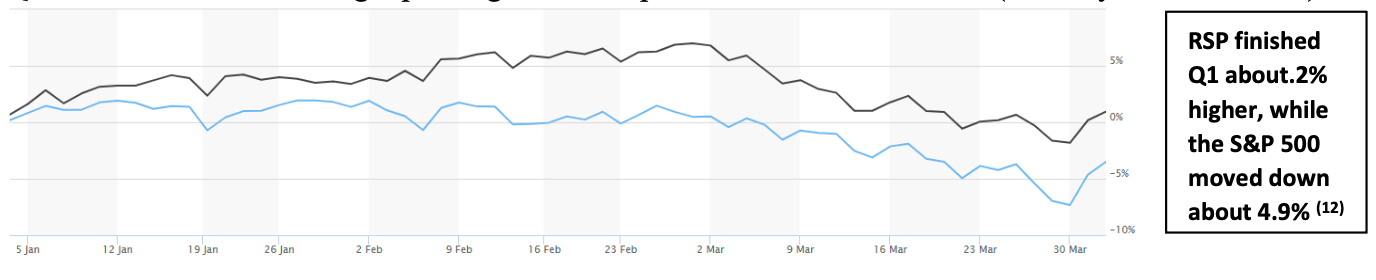
Within our quarterly commentary we aim to discuss trends happening within the broad stock market, and if possible, allow our readers to freely enact similar trades. As you remember, we've been focused on the Mag 7, and you can catch up on the details on what that is, and what risks pertain to the Mag 7 by reading our previous quarterly review. We focused particularly on how highly concentrated major indexes such as the S&P 500 have become as it relates to these seven huge companies. At that time, those seven companies made up over 35% of the S&P 500. For the first time since the Artificial Intelligence boom began in January 2023, every Mag 7 stock is down for the year. The Mag 7 companies in total have shed over $2 Trillion in value as of late March. As you may remember in Q4 of last year we moved about 10% of our holdings in the iShares Core S&P 500 Fund ETF (ticker IVV) to Invesco S&P 500 Equal Weight ETF (ticker RSP) and predicted the Mag 7 stocks, which offered a P/E ratio of about 29 compared to the broad index P/E ratio of about 20, would experience selling from investors who had gains and were waiting for the new year to book the sell orders in 2026. As predicted Q1 '26 was hard on the Mag 7 pushing those companies about 12.16% lower (ticker symbol "MAGS").
Whether you're new with me or an original client from nearly 14 years ago, whether your investment account is $1,000 or $10,000,000, it means a lot to me and it is an honor to work with you on your goals. As you've noticed, I try not to let the highs get too high, or the lows too low. Thus, I do get cautious when everything seems euphoric, for example in times recently of the Dow Jones hitting 50,000 and the S&P 500 hitting 7,000. It is not that I think the market will fall, it's just I have come to accept how things function. The market has historically tended to take the escalator up and grind higher over time, then suddenly take the elevator down in a harsh brief fall. I've come to accept that a 21-mile body of water can disrupt the stock market 5%, 10%, perhaps more. From there my duty is to educate you and warn you about these periods and be your steady hand through them. Generally speaking, there are a few things you may want to consider this quarter more than last quarter. Contributing to the down market, converting from a traditional IRA to a Roth IRA, using Moore F.S. to invest your short-term savings into treasury bonds for greater yields compared to banks as applicable to your unique circumstances. These could all potentially help strengthen your financial efficiency. Please reach out to me if you'd like to discuss these or any other items in greater detail, I love to hear your ideas! Thank you for the opportunity to work with your account and please don't hesitate to tell a friend about Moore F.S.

Did you know? Moore Financial Solutions offers unique/custom-built insurance solutions. Does anything keep you up at night that we could help fix? If so give us a call and we’ll help find you the best policy rates and options as we shop the open market of providers, all while offering our zero-pressure sales process. This includes Life Insurance, Disability Income Insurance, and Long-Term Care Insurance. Let’s review your policy and search for Moore Solutions today!
1. https://finance.yahoo.com/quote/%5EGSPC/history/
2. https://finance.yahoo.com/quote/%5EGSPC/history/
3. https://finance.yahoo.com/quote/%5EGSPC/history/
4. https://finance.yahoo.com/quote/%5EGSPC/history/
5. https://www.investopedia.com/terms/d/dutch_tulip_bulb_market_bubble.asp
6. https://www.worldometers.info/geography/largest-countries-in-the-world/
7. https://www.dallasfed.org/research/economics/2026/0320
8. https://www.dallasfed.org/research/economics/2026/0320
9. https://www.techi.com/magnificent-seven-stocks/
10. https://www.techi.com/magnificent-seven-stocks/
11. https://www.marketwatch.com/investing/fund/mags/charts?mod=mw_quote_advanced
12. https://www.marketwatch.com/investing/index/spx/charts?mod=mw_quote_advanced
This material has been prepared for information and educational purposes and should not be construed as a solicitation for the purchase or sale of any investment. The content is developed from sources believed to be reliable. This information is not intended to be investment, legal or tax advice. Investing involves risk, including the loss of principal. No investment strategy can guarantee a profit or protect against loss in a
period of declining values. Past performance may not be used to predict future results. Investment advisory services offered by duly registered
individuals on behalf of CreativeOne Wealth, LLC a Registered Investment Adviser. CreativeOne Wealth, LLC and Moore Financial Solutions
are unaffiliated entities. Licensed Insurance Professional. Insurance product guarantees are backed by the financial strength and claims-paying
ability of the issuing company.